The terms IPTV and OTT are often confused, but they represent different approaches to delivering video content over the internet. Understanding the difference helps you choose the right service for your needs. This guide explains IPTV vs OTT, how they work, and which is better for different use cases.
What Is IPTV?
IPTV (Internet Protocol Television) delivers live TV channels over a managed, private network. Your ISP or a dedicated IPTV provider maintains the infrastructure. IPTV uses multicast streaming — one signal reaches many viewers simultaneously, which is highly efficient for live broadcasts. IPTV typically requires a set-top box or dedicated device. See our IPTV basics guide for more detail.
What Is OTT?
OTT (Over-the-Top) delivers video content over the public internet without a managed network. Services like Netflix, Hulu, YouTube TV, Disney+, and Amazon Prime Video are OTT. Content is delivered via unicast streaming — each viewer receives an individual stream. OTT works on any device with an internet connection and a browser or app.
Key Differences: IPTV vs OTT
- Network: IPTV uses managed/private networks; OTT uses the public internet
- Streaming method: IPTV uses multicast; OTT uses unicast
- Infrastructure: IPTV requires dedicated infrastructure; OTT works over any internet connection
- Content type: IPTV is primarily live TV; OTT is mostly on-demand with some live options
- Quality: IPTV offers consistent quality on managed networks; OTT quality depends on your internet speed
- Device support: IPTV requires dedicated boxes or apps; OTT works on virtually any device
- Scalability: IPTV can strain with many viewers; OTT scales well via CDNs
Advantages of IPTV
- Live TV focus: IPTV excels at live channel delivery with minimal delay
- Consistent quality: Managed networks provide stable bitrates
- Channel packages: Traditional channel bundling similar to cable
- Lower latency: Live sports and events are closer to real-time
- Broadcast efficiency: Multicast reduces bandwidth for popular channels
Advantages of OTT
- Content library: Massive on-demand catalogs (movies, series, originals)
- Device flexibility: Watch on phone, tablet, smart TV, laptop, game console
- No contract: Monthly subscriptions with no long-term commitment
- Personalization: AI-driven recommendations and user profiles
- Global availability: Access content from anywhere with internet
Can IPTV and OTT Work Together?
Yes, many users combine both. Use an IPTV service for live channels, sports, and international programming. Subscribe to OTT services for on-demand content and original series. This hybrid approach gives you the best of both worlds — live TV from IPTV and streaming libraries from OTT platforms.
Cost Comparison
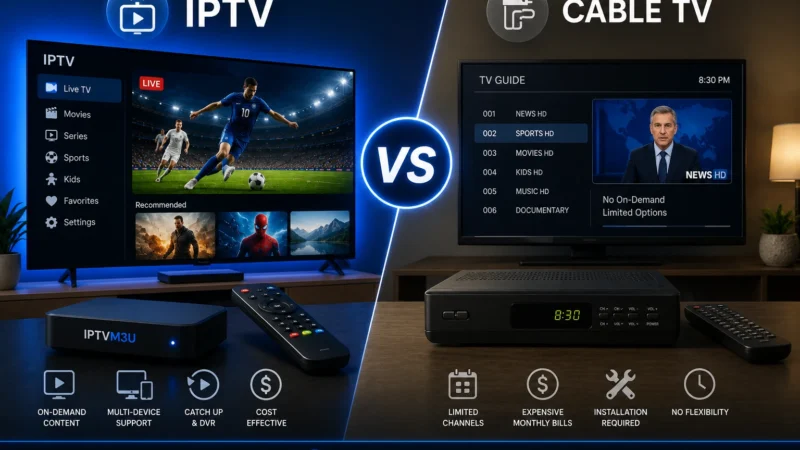
IPTV services typically cost $10-20 per month for hundreds of live channels. OTT services range from $7-20 per month each (Netflix, Hulu, Disney+, etc.). A combination of 2-3 OTT services plus IPTV costs roughly $30-50 per month — still less than a typical cable subscription. See our IPTV vs cable comparison for more pricing details.
Which Should You Choose?
- Choose IPTV if you watch mostly live TV, sports, and international channels
- Choose OTT if you prefer on-demand content, movies, and original series
- Choose both for the most comprehensive entertainment setup
Further Reading